
When humanity last stood upon the Moon during the Apollo missions over fifty years ago, the journey across the 400,000-kilometre gulf was defined by monumental state-funded budgets and raw national effort. Today, the modern space landscape looks vastly different. Financial budgets are relatively more constrained, computing power and automation have advanced far beyond the imaginations of early science fiction writers, and commercial opportunities across the space domain have expanded exponentially. Beyond the immediate goal of In-Situ Resource Utilisation – harvesting lunar power, water, and minerals – commercial operators are preparing for breakthroughs in low-gravity manufacturing, medicine, computing, logistics, and scientific research. However, establishing a permanent human presence on the Moon requires solving an entirely unprecedented engineering dilemma: learning how to stay.
Returning to the Moon permanently demands a complete reimagining of mechanical machinery, spanning engineering design, daily operations, and long-term maintenance. To operate reliably, equipment must survive environmental conditions that are profoundly hostile to both biology and traditional hardware. On the surface, the absence of atmospheric pressure creates a hard vacuum, causing standard fluids to boil away in moments. Equatorial surface temperatures swing from balmy spikes of up to 130°C during the lunar day down to -173°C during the two-week night cycle. Furthermore, surface radiation averages roughly 60 micro sieverts per hour – approximately 200 times Earth’s background radiation – with Solar Particle Events threatening lethal doses of proton radiation within hours.
Among all environmental hazards, lunar regolith presents perhaps the most insidious mechanical challenge. Unlike terrestrial soil, lunar dust has never been smoothed or weathered by wind or water. Every microscopic grain is sharp, angular, and jagged. Radiation on the surface imparts an electrostatic charge to the particles, causing them to hover above the ground in a suspended, razor-sharp fog. If inhaled inside a habitat, regolith causes catastrophic biological lung damage. For mechanical hardware, it acts as an aggressive abrasive that penetrates seals, joints, gears, and bearings. It scratches optical surfaces and sensors, clogs radiators and filters, coats electrical contacts, and steadily erodes every moving part.
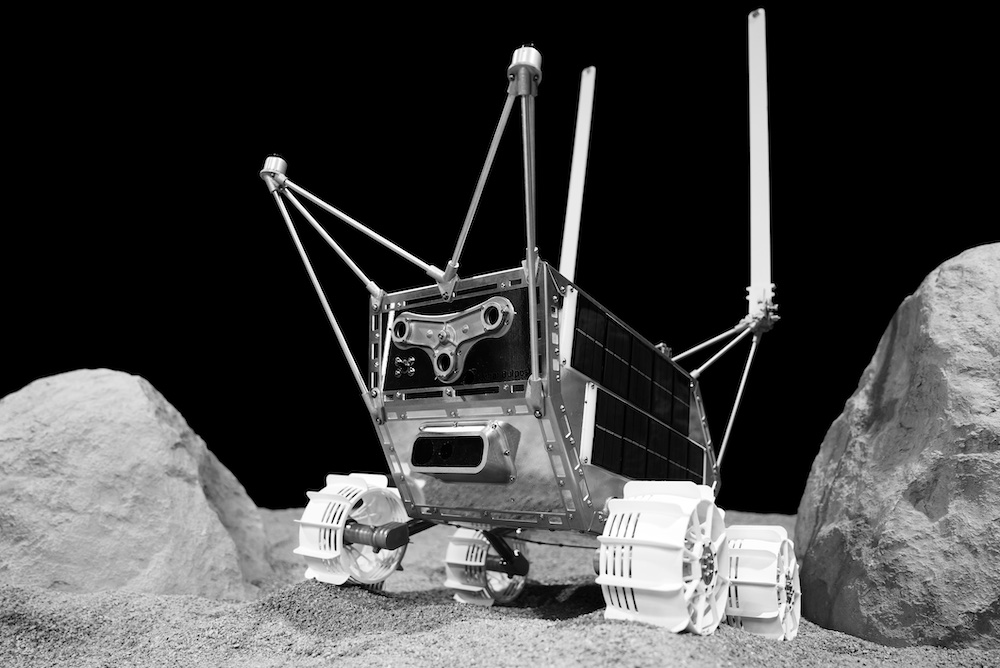
Overcoming these environmental barriers requires specialised technical capabilities, leading to strategic collaborations between commercial space companies and chemical technology leaders. Lunar Outpost, a company focused on building the robotic infrastructure for future space exploration and commerce, is developing uncrewed rovers and crewed vehicles designed to make the lunar surface accessible, sustainable, and open for innovation. Among its primary assets is the Mobile Autonomous Prospecting Platform (MAPP), a rover bound for exploration missions to the lunar south pole as part of Intuitive Machines’ IM-3 mission later in 2026, alongside future Artemis project deployments. Supporting this mission is Castrol, a brand with over seven decades of space collaboration heritage.
Leading Castrol’s involvement in this initiative is Chris Lockett, Senior Vice President of Castrol Technology, who oversees the company’s global technology innovation across industrial fluids, automotive applications, data centres, electric mobility, and space programmes. Lockett’s path into chemical engineering began early under the guidance of his father, who was himself a chemist.
“I chose chemical engineering because it was kind of in the area, physics, chemistry, maths was all in there, but it was also training to be a chemical engineer, which was a job that I could move into when I when I graduated, and that’s what I did when I left university,” Lockett explains. “I was a chemical engineer, so I used to design and build chemical plants, and for BP because Castrol is part of part of the BP group… I designed, commissioned, and built chemical plants for about five years… But then I broadened within the BP group, and I did a few different roles, strategy type roles in headquarters, and that’s where I discovered Castrol… And yeah, I fell in love with Castrol and everything that Castrol does.”
The relationship between Castrol and Lunar Outpost reflects a broader shift across the aerospace sector, where commercial partnerships are increasingly replacing or augmenting traditional government-led endeavours.
“With our heritage and history and track record in the space industry, we’ve got lots of partnerships from lots of different companies, and certainly what everybody has seen in recent years that there’s been a lot more commercial organisations getting involved with the space industry rather than it just being kind of governmental led partnerships,” says Lockett. “So we’ve got a long-standing relationship with NASA, but in more recent years, we’ve started to form these partnerships with some commercial organisations, and Lunar Outpost is one of those fantastic sort of commercial organisations that we formed a partnership with.”
This collaboration extends beyond simply formulating specialised fluids. Castrol also assisted Lunar Outpost in designing its mission control center, establishing operational monitoring systems that parallel those used in Formula One racing. In both high-stakes environments, teams of specialised experts monitor endless streams of telemetry data to track the performance of microscopic components, feeding real-time guidance back to operators and equipment. To capture this engineering journey, the teams filmed a documentary titled Drive Me to the Moon, highlighting the multi-year effort to build a rover capable of navigating untouched lunar territory.
“And when you watch the documentary, it’s the people, these scientists and these technologists that are doing something that they’re so invested in, and I think that comes through really clearly in the documentary: the passion and the kind of the excitement, the nervousness. The kind of magnitude of what people are trying to do-it’s incredible,” Lockett observes.
Formulating lubricants for lunar deployment demands fundamental chemical adaptations to cope with extreme environmental swings. Standard terrestrial formulations are incapable of functioning across the vast thermal spectrum encountered in space.
“Clearly what’s different with space and the products that we develop there versus the products that we develop here on Earth are the conditions that we see,” Lockett notes. “So in space, you see really big temperature swings, so that it can be really cold, but it can also be really hot. So you have to design a product that is going to continue to behave as a lubricant and. Continue to provide the performance that’s required over that enormous temperature range.”
A primary hazard in vacuum conditions is outgassing, an accelerated form of evaporation. On Earth, a puddle of water slowly evaporates over time, but under a high vacuum, liquid volatility is drastically amplified.
“When you have a high vacuum, that effect is accelerated, right? So what we have to develop are products that aren’t going to outgas and give that give that issue, and the reason why that’s so important is if you do get outgassing, essentially what you’re doing is you’re losing product,” Lockett explains. “So over time, your product will disappear and therefore not be there, not provide the performance that’s required. The other issue it can cause, even with small amounts of outgassing, is that those particles that are coming off the surface of the lubricant can find their way to other parts of the spacecraft or other parts of the instrumentation.”
This outgassing risk was famously illustrated during maintenance on the Hubble Space Telescope, where volatile particles from lubricants threatened to condense onto sensitive optical lenses, obscuring clear views of distant galaxies.
“Outgassing there, you could get gas particles coming off the lubricant, finding their way to a lens, condensing back into a liquid or a solid onto… the lens, and suddenly that pinpoint crystal-clear image that you’re looking for isn’t possible, right? So that’s why it’s so important,” Lockett says.
Given these stakes, testing protocols for space lubricants must be exceptionally rigorous. Castrol utilises a three-pronged development methodology combining physical environmental testing, computational modelling, and historic operational data. Physical testing includes subjecting lubricants to extreme hot and cold environmental chambers, high-vacuum test cells, and sub-zero Arctic field trials used for terrestrial automotive validation. Modern computational tools further allow chemical engineers to simulate molecular behaviour under space conditions prior to physical manufacturing.
“Those things combined-real physical testing, plus simulation, plus your experience and know-how-those those things combined allow you to develop products that that will work and be successful, and with space, of course, it is really, really important that these things work and they continue to work,” says Lockett. “Because for Castrol, we have got hundreds of 1000s of workshops on the surface of Earth where you can go and change your lubricant in your car, change. Jet engine oil, but as of now, we don’t yet have a Castrol workshop on the surface of Mars or the surface of the Moon. So therefore, the products that we create need to work because failure isn’t an option.”
Despite the absence of lunar garages, history does record at least one official orbital oil change. On the International Space Station, astronauts noticed unexpected juddering and vibrations occurring as large robotic arms manoeuvred the station’s solar panels to face the sun.
“The space station has got these big solar panels attached to it that operate on these masts, and the masts are basically big kind of robotic arm levers that move, and they move so that the solar panels are facing towards the sun, and you can generate the power that’s needed,” Lockett recounts. “And on one of the missions, what they the astronauts on the ISS were feeling some vibrations and some movements, and that’s you know you do not want vibrations or movements or judders on the International Space Station. And it was when the masts were turning and manoeuvring the solar the solar panels. So what they did is a subsequent team of astronauts went up, and they went up with some new Castrol breakups grease, and they went out onto the masts on a spacewalk, and they removed the previous product that was being used, and they replaced that with a Castrol product, and then that fixed the problem.”
While the space environment presents unique technical hurdles, the core chemical principles developed for off-world applications directly inform terrestrial engineering. Lessons learned from lubricating robotic joints like the Space Shuttle’s Canadarm or lunar exploration vehicles translate directly to terrestrial manufacturing, where automated robotic assembly lines now build 80 to 85 percent of modern vehicles, and where humanoid robotics are rapidly emerging.
“In terms of the actual chemistry itself, the chemistry in space is very unique. But what we’re doing is fundamentally the same,” Lockett reflects. “You are looking to lubricate moving parts. You’re looking to reduce friction, reduce wear, remove. Contaminants prevent corrosion and ultimately stop systems from breaking down. So, things that you learn can be applied to other applications on Earth as well.”
The history of engineering is often represented by visible outputs – bridges, tunnels, and rockets. Yet every monumental achievement relies upon a complex web of quiet innovations, with lubrication standing among the most critical. As humanity prepares to return to the Moon to stay, success will require the convergence of materials science, robotics, power systems, communications, manufacturing, and chemistry. There is still work to be done, but technologies have converged, the Moon is waiting, and the time is now.