
Four Central American countries, Guatemala, El Salvador, Nicaragua and Costa Rica are undertaking public testing of an earthquake early warning system.
The project is known as Alerta Temprana de Terremotos en América Central (ATTAC). ATTAC is being run in collaboration with those nations’ relevant agencies and the Swiss Seismological Service at ETH Zürich.
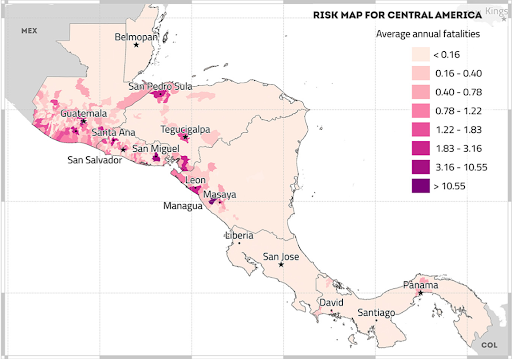
Central America is one of the Earth’s highest risk regions for earthquakes. Less than 24 hours before the announcement of the systems testing Guatemala was hit by a 6.7 magnitude earthquake that was felt in neighbouring countries, Costa Rica and El Salvador.
ETH Zürich’s project coordinator John Clinton said, “In every one of these countries, in living memory, earthquakes have occurred that have had significant fatalities, often in the capital cities. More than twenty thousand people have died in two of the four countries [Nicaragua and Guatemala] in the 1970s, so there is raw feeling and raw emotion. Further, on a regular basis, people are experiencing felt earthquakes.”
Earthquake early warning algorithms are now installed in all of the four participating countries, along with 71 motion stations installed in areas of weak coverage, mostly in Guatemala. System tests have shown that it can identify earthquakes within 10 to 20 seconds of originating and produce the warnings seconds before any ground-shaking waves reach land.
Most existing earthquake early warning systems only send alerts to areas that experience ground-shaking above a certain threshold. The ATTAC system however will alert the entire country. John Clinton explains, “Most Central American countries are small, they are similar size to Switzerland or Greater Los Angeles. So our first approach is if you have something that’s relevant to any part of the country, alert the whole country.”
The warning messages that are to be sent out to residents will be experimented with, as more common messages, such as “duck, cover and hold” may not work best in countries where mud-block buildings with heavy roofs are very prone to collapse.
The plan is for the project to last two years, in which time the early warning system should be in full operation in Nicaragua and the other three countries will get a start on implementing the system.