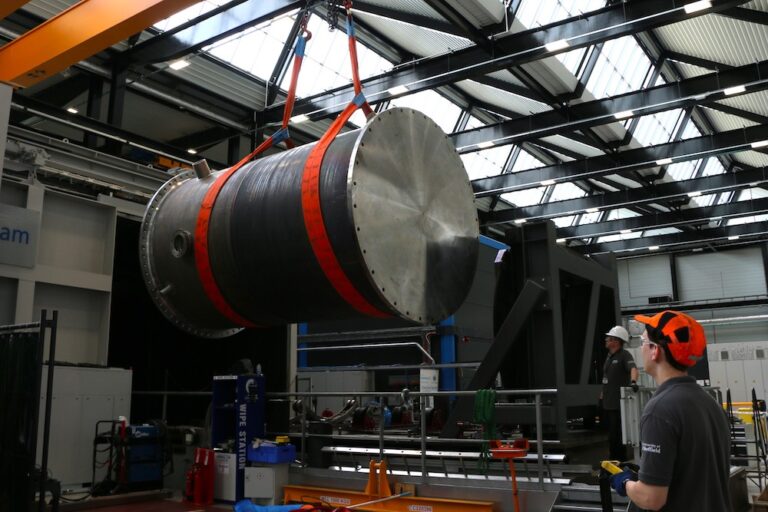

A UK experiment to find new ways of creating materials that could be used to produce medicines and metal alloys started its journey to the International Space Station (ISS).
The Particle Vibration experiment has been led by the University of Strathclyde and built by UK-firm Qinetiq. It took off from the Kennedy Space Center in Florida on a SpaceX Falcon 9 rocket on 26 November.
The idea is to use vibrations to allow contactless control of particles to create new types of metal alloys and other structures that would not be possible on Earth. The team said the experiment could also lead to new methods of cooling nuclear reactors.
A spokesperson for the UK Space Agency said, “Astronauts on the ISS will use the equipment in an experiment that involves heating and shaking complex fluids – liquids that contain fine solid particles or other liquid droplets – in space’s microgravity environment to create new materials. This cannot be achieved on Earth, as the planet’s gravity tends to separate complex fluids into their individual components, according to their weight.
“This results in a concentrated layer of particles on the bottom or on the top of the container, which would then prevent the production of these materials with the desired properties.