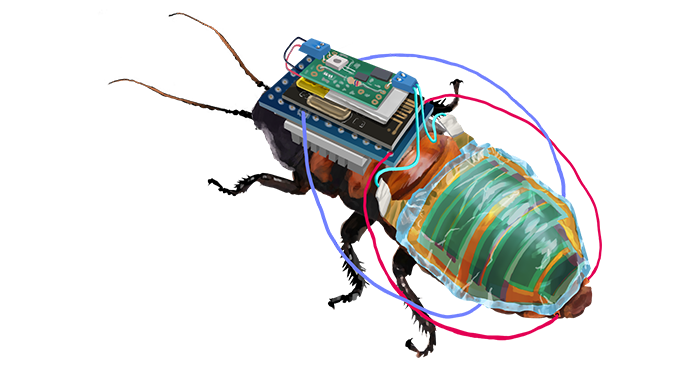

A team of researchers at RIKEN Cluster for Pioneering Research in Japan, have created a cyborg cockroach. Using a small wireless control module powered by a rechargeable battery connected to a fuel cell, the researchers attached ultrathin, flexible electronics that allow the cockroach to move freely.
The hope is cyborg insects would be able to inspect and monitor particularly hazardous environments. Handlers will control the cyborg insects through wireless remote control of their leg segments.
The key challenge was to build a power module that could remain charged for long periods of time, so time-sensitive missions would not be disrupted. The solution was an on-board solar cell that allows the battery to remain continuously charged.
The researchers also found that cockroaches’ abdomens change shape and portions of the exoskeleton can overlap. To accommodate this the researchers interleaved adhesive and non-adhesive sections that allows the electronics to stay attached while keeping the cockroaches full range of movement.
To attach the electronics, battery and recharging solar cell to the cockroach the team of researchers 3D-printed a ‘backpack’ using an elastic polymer that stays attached to the cockroach for long periods of time while allowing for full and free natural movement.
“The body-mounted ultrathin organic solar cell module achieves a power output of 17.2MW, which is more than 50 times larger than the power output of current state-of-the-art energy harvesting devices on living insects,” said lead researcher Kenjiro Fukada.
In tests after attaching the electronic to the cockroach the battery was charged using pseudo-sunlight and then the cockroaches were made to turn left or right using a remote control.