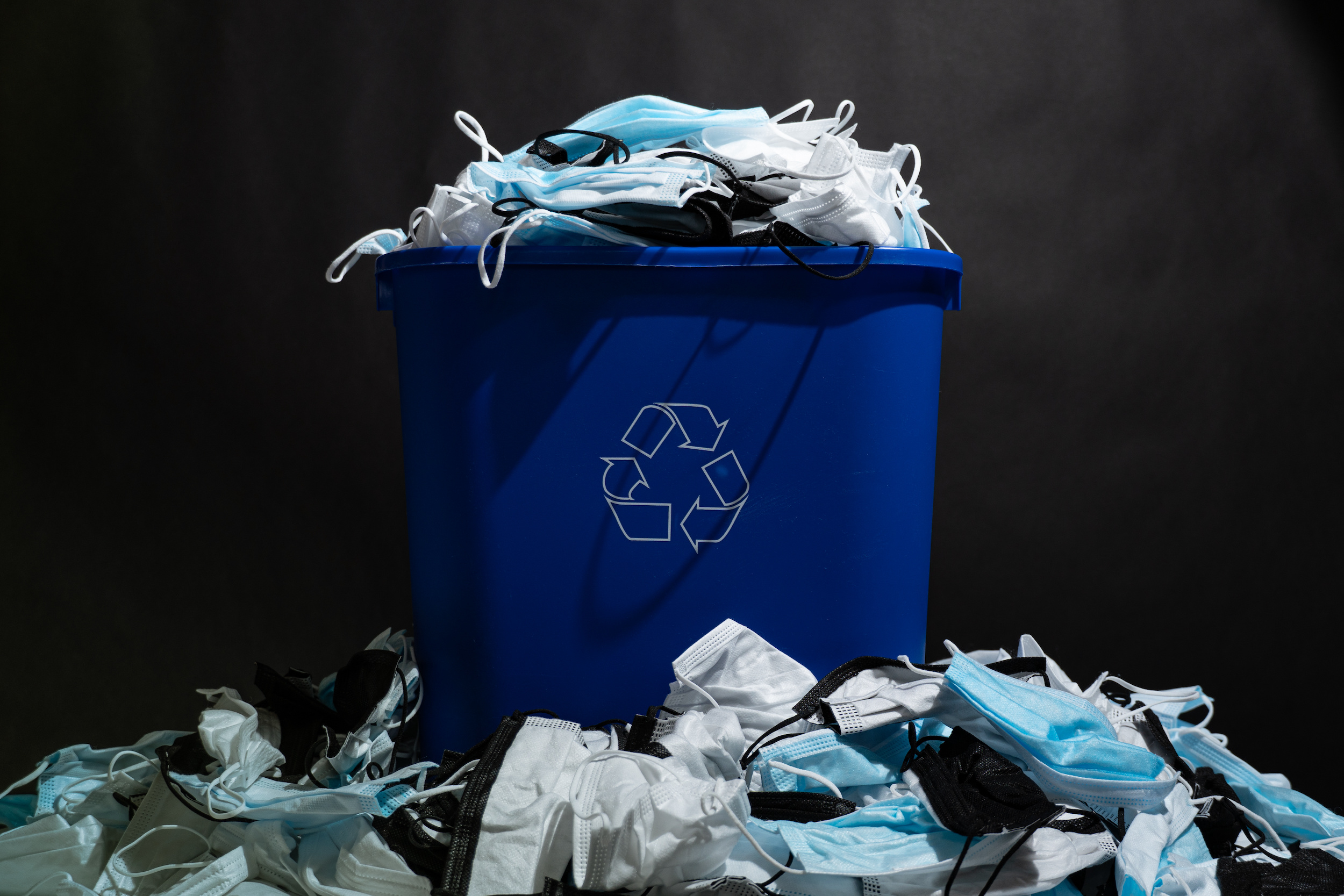

Engineers at RMIT University in Melbourne have published studies for reinforcing structural concrete using recycled personal protective equipment (PPE). The process aims to provide a circular approach to disposable healthcare waste.
According to an article in The Engineer, since the beginning of the Covid-19 pandemic an average of approximately 54,000 tonnes of PPE waste has been created globally each day. The established method of disposal for this equipment is for it to enter landfill or incineration.
Taking this into account the research team undertook preliminary investigations, published in 2021, regarding the feasibility of incorporating polypropylene fibres from single-use face masks into concrete to improve its mechanical properties. Testing focused on compressive strength, indirect tensile strength, modulus of elasticity and ultrasonic pulse velocity. Introduced at five different volumes – 0% (control), 0.10%, 0.15%, 0.20% and 0.25% – the team discovered an increase in the overall quality and the strength properties of the concrete. Despite this, the testing involving volumes over 0.20% led to a decline in the increasing strength.
More recently the researchers released a study considering the additional use of shredded plastic-based isolation gowns in structural concrete. Undertaking a series of experiments alongside an SEM-EDS analysis they investigated the response of the concrete with the gowns added to aggregates at 0.01%, 0.02% and 0.03%. They observed an improved bridging effect between the cement matrix and the shredded isolation gowns. Furthermore, the compressive strength, flexural strength and modulus of elasticity demonstrated improvements of 15.5%, 20.6% and 11.73% respectively.
The team hopes this will assist in avoiding the path to landfill seen by PPE and improve materials to create better products while taking a circular economy approach.