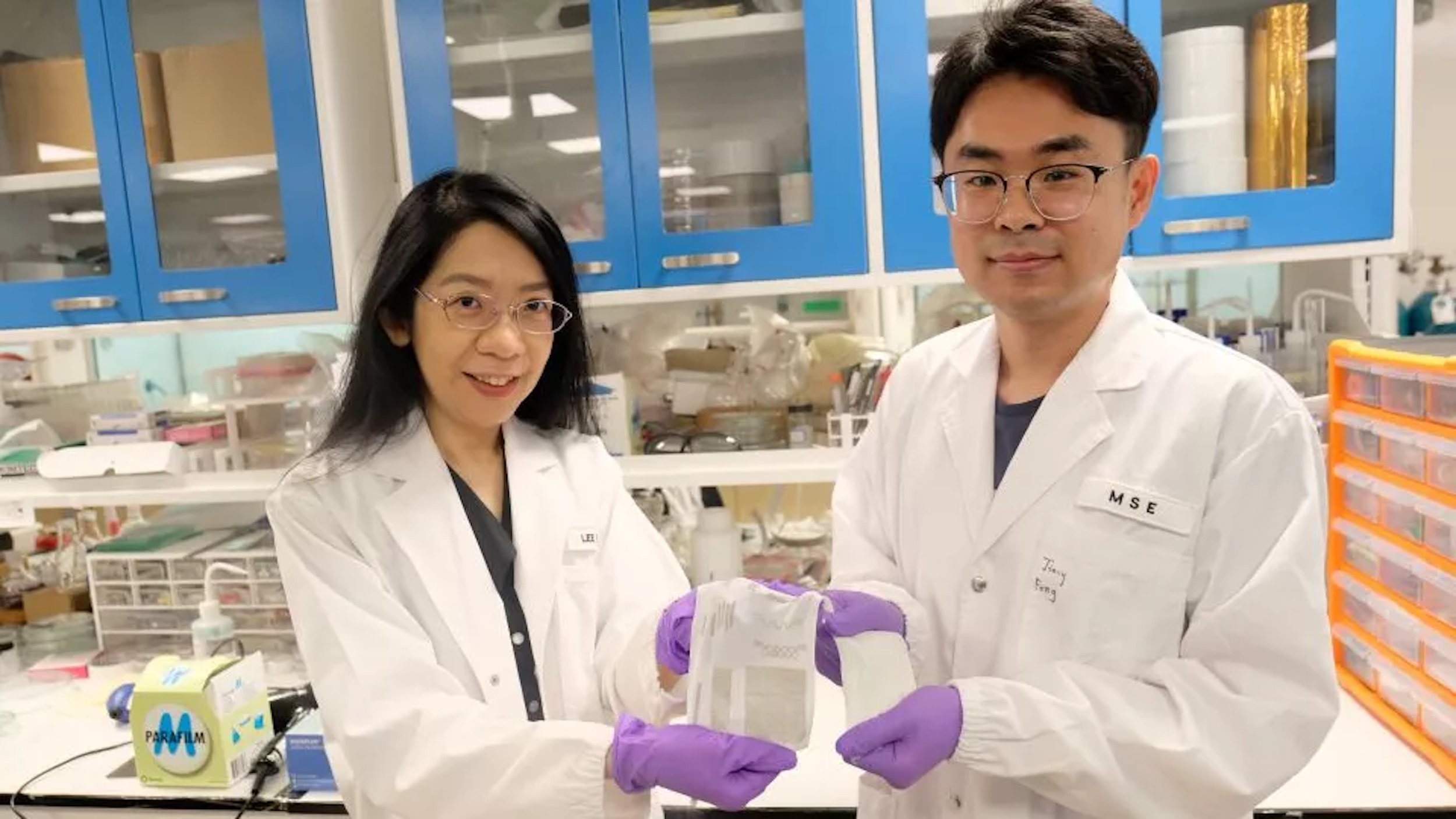

A team of scientists at the Nanyang Technological University (NTU) Singapore have developed a fabric that converts the mechanical stress put onto the fabric through movement into electrical energy.
It is made with a stretchable spandex base layer and a rubber like material to keep it flexible and waterproof. It can be washed, folded o crumpled without any effect on performance and the team of scientists claim it will maintain a stable electrical output for five months.
In an experiment they conducted to show proof of concept the NTU Singapore team demonstrated that tapping on a 30mm piece of the fabric was able to generate enough electricity to turn on 100 LEDs.
The prototype fabric produced in Singapore is able to generate 2.34W of electricity per square metre of fabric, which is enough to power small electronic devices.
Materials scientist and NTU Associate Professor Lee Pooi See, and the lead on the study, said: “There have been many attempts to develop fabric or garments that can harvest energy from movement, but a big challenge has been to develop something that does not degrade in function after being washed, and at the same time retains excellent electrical output. In our study, we demonstrated that our prototype continues to function well after washing and crumpling. We think it could be woven into t-shirts or integrated into soles of shoes to collect energy from the body’s smallest movements, piping electricity to mobile devices.”
To fabricate the prototype, the scientists first made a stretchable electrode by screen-printing an ‘ink’ comprising silver and styrene-ethylene-butylene-styrene (SEBS). This electrode is then attached to a piece of nanofiber fabric that is made up of poly(vinylidene fluoride)-co-hexafluoropropylene (PVDF-HPF), a polymer that produces an electrical charge when compressed, bent, or stretched; and lead-free perovskites.