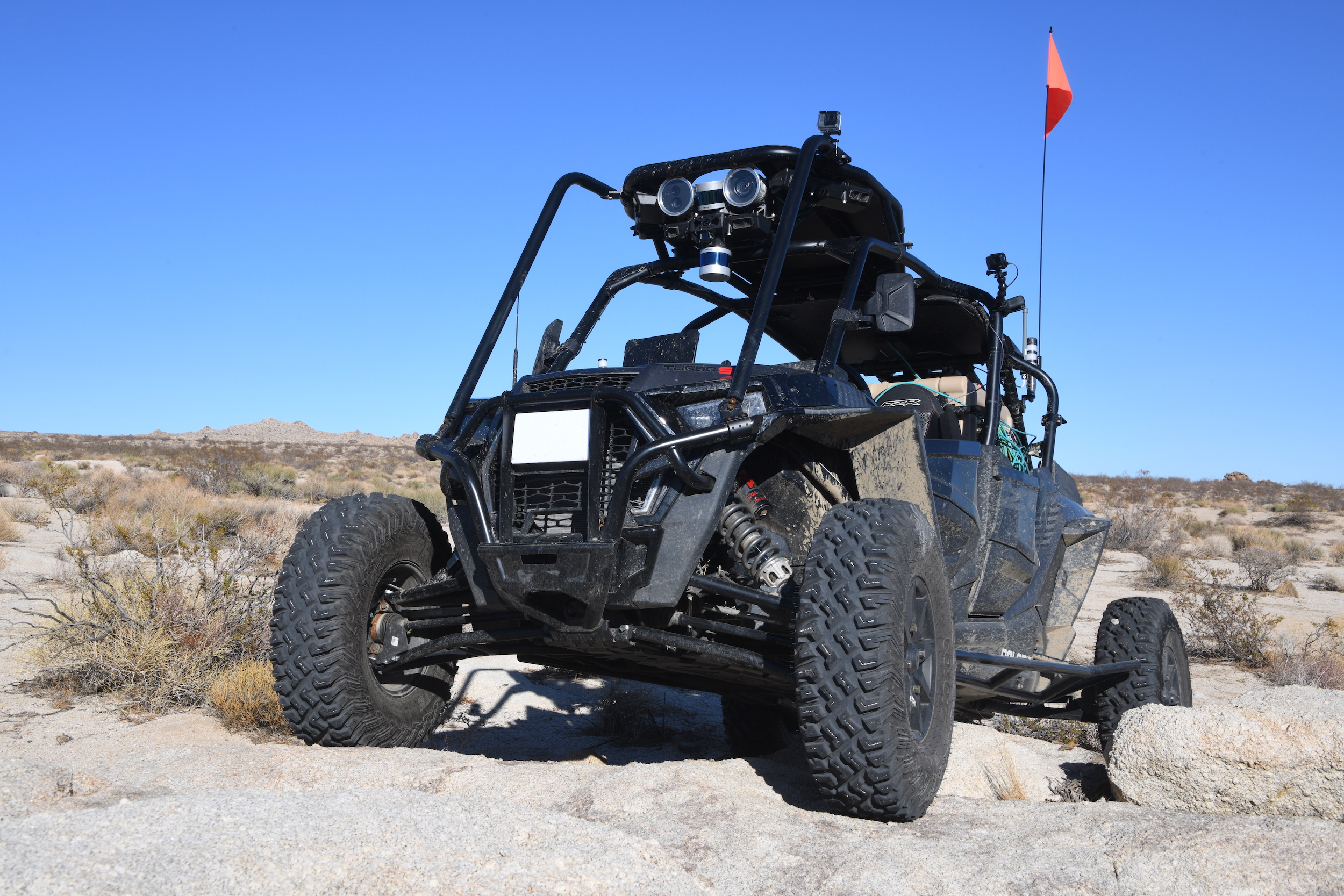

Four uncrewed ground vehicles (UGVs) are ready and four more are expected to take part in a high-speed off-road experiment next month. The Robotic Autonomy in Complex Environments with Resiliency (Racer) project aims to advance autonomous vehicles to such an extent that they can keep pace with or even go faster than piloted vehicles over rough terrain.
The project was commissioned by Darpa, the ‘Defense and Advanced Research Projects Agency’. It is a research and development agency within the United States Department of Defense and is responsible for the development of emerging technologies.
In November the selected teams received ‘Racer Fleet Vehicles’ (RFVs) from Darpa. These are high performance all-terrain vehicles outfitted with high-end sensing and computational abilities. The teams then used these to develop platform-based autonomy for testing in the field.
A spokesperson for Darpa said, “RFV robots include 360° range and image sensing, such as multiple LIDARs, stereo camera pairs, colour and infrared imaging cameras, radar, event sensors, and inertial measurement sensing. Computation tools have multiple best-of-class graphical processing units in an environmentally protected, shock/vibration proof, and thermally managed electronics box that is specifically engineered for the demands of the high speed, off-road terrain expected in Darpa’s tests.”
The sensors collect four terabytes of data per hour to feed the artificial intelligence algorithms, so the vehicle can learn how to make fast-paced manoeuvres in complex terrain. Darpa provided teams with 100 terabytes of data to prepare their systems.