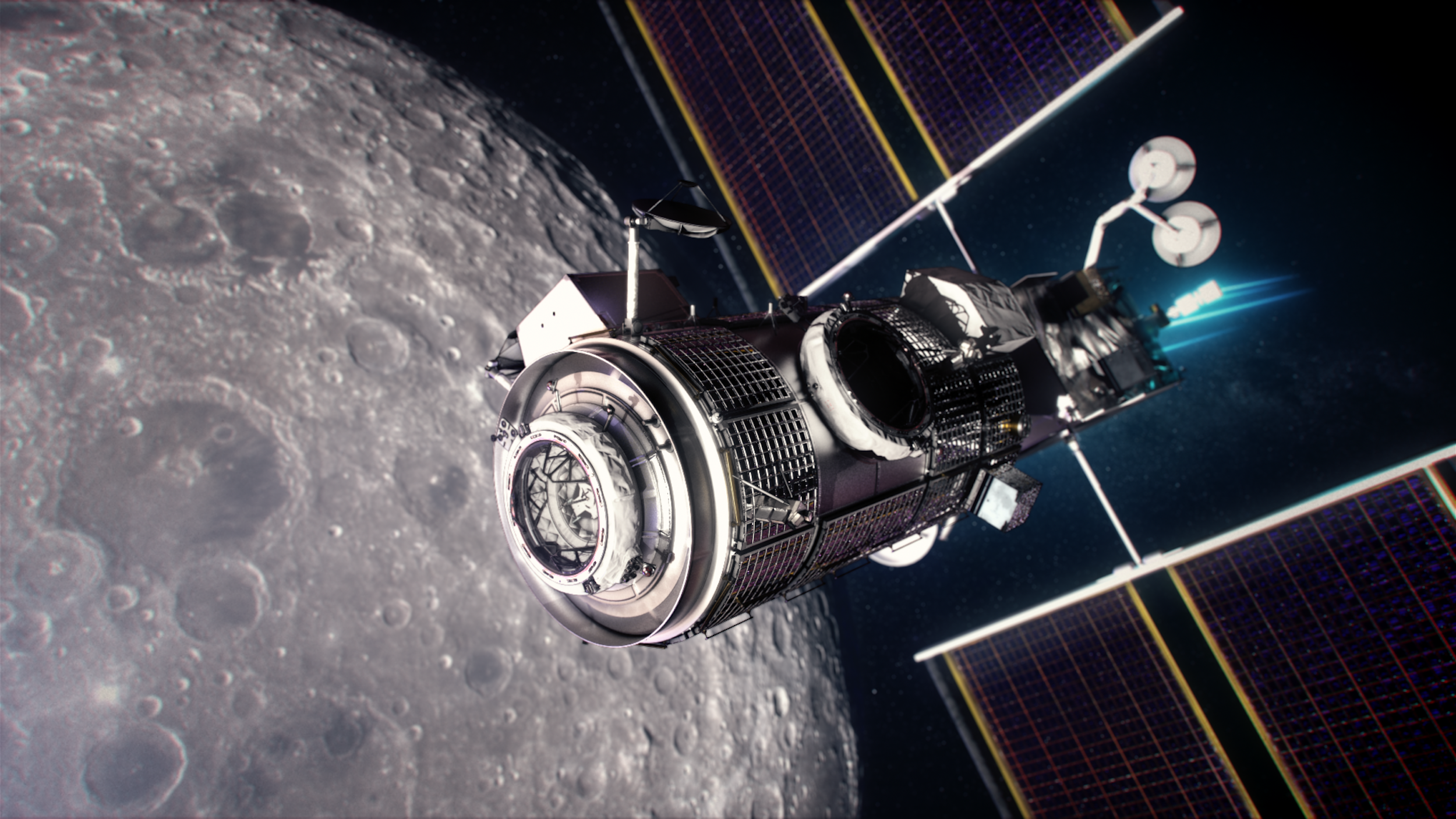

A major component of the Lunar Gateway space station has passed a preliminary design and programme review. It will now move into the final design phase and could be launch-ready as early as November 2024.
The mission is called Hermes, which is short for Heliophysics Environmental and Radiation Measurement Experiment Suite. It will monitor space weather, which refers to the fluctuating conditions in space driven by the Sun. This primarily includes the steady stream of particles and magnetic fields known as the solar wind, as well as blasts from billion-tonne gas clouds known as coronal mass ejections. Yet more hazardous are solar flares, which are ultra-bright flashes of light.
All of these emissions can create scientifically interesting disturbances in space, but some are hazardous to human and robotic operations.
Hermes will be mounted outside the Habitation and Logistics Outpost module of Gateway, where the crew will live and work as they orbit the moon.
A spokesperson for Nasa said, “Hermes will study space weather in an especially variable environment. As the Moon orbits Earth each month, it spends about one week inside Earth’s long magnetotail, the portion of our magnetic field blown back from the Sun like a windsock.
“When inside the magnetotail, Hermes will be flooded by particles and magnetic fields that have interacted with Earth. The remaining three weeks, the Moon confronts the unfiltered Sun, measuring the solar wind and space weather in conditions closer to pristine interplanetary space.”
Jim Spann, Hermes program scientist at NASA, added, “Hermes is the first space weather monitoring platform on a crewed spacecraft to venture outside Earth’s protective magnetic field,” added “What we learn from Hermes will be critical to protecting astronauts as we venture forth with the Artemis mission.”
The Lunar Gateway will be an outpost orbiting the Moon that will provide vital support for the lasting human return to the lunar surface, as well as a staging point for deep space exploration, listen to #118 Gateway: The Lunar Space Station in which we interview two Nasa scientists about the project.